
Industrial And Residential Epoxy Coatings
Epoxy Coatings Australia
If you’re looking for a durable, long-lasting floor coating for industrial or residential spaces, epoxy coatings are one of the most reliable solutions available. They provide a seamless, hard-wearing surface that resists chemicals, heavy traffic and daily wear.
Whether you need a strong coating for a warehouse or a clean, modern finish for your home, epoxy systems can be tailored to suit different environments and performance needs.
Below is a quick comparison to help you understand the difference between industrial and residential epoxy coatings:
| Feature | Industrial Epoxy | Residential Epoxy |
|---|---|---|
| Use | Factories, warehouses | Garages, homes |
| Durability | Very high | High |
| Chemical Resistance | Excellent | Moderate to high |
| Appearance | Functional | Decorative |
Get a Free Quote
What Are Industrial and Residential Epoxy Coatings?
Epoxy coatings are high-performance systems made by combining resin and hardener to create a rigid, protective layer over concrete surfaces. Once cured, the coating forms a seamless finish that is resistant to wear, impact and chemicals.
Industrial systems are designed for heavy-duty environments where strength and resistance are critical, while residential coatings focus more on appearance, ease of maintenance and everyday durability.
Where Are Epoxy Coatings Used?
Epoxy coatings are widely used across both industrial and residential settings:
- Warehouses and factories
- Workshops and production areas
- Commercial and retail spaces
- Residential garages and driveways
- Interior living areas
Benefits of Epoxy Coatings
Epoxy coatings offer a wide range of benefits for both residential and industrial use:
- Strong and highly durable surface
- Resistant to chemicals, stains and spills
- Easy to clean and maintain
- Seamless and dust-free finish
- Long lifespan with minimal maintenance
These advantages make epoxy one of the most cost-effective flooring solutions over time.
Types of Epoxy Coating Systems
Different environments require different systems. Common types include:
- Self-levelling epoxy (smooth, seamless finish)
- Flake systems (decorative and slip-resistant)
- Polyurethane coatings (flexible and UV resistant)
- Polyaspartic coatings (fast curing and durable)
Industrial vs Residential Epoxy – Key Differences
| Feature | Industrial Epoxy | Residential Epoxy |
|---|---|---|
| Primary Use | Heavy machinery, warehouses, factories | Garages, homes, light-use areas |
| Focus | Performance and durability | Appearance and easy maintenance |
| Thickness | Thicker, heavy-duty systems | Moderate thickness |
| Complexity | More technical and specialised | Simpler application |
| Finish | Functional and industrial look | Decorative and custom finishes |
Direct. Durable. Dependable.
Our Epoxy Coating Process
A professional epoxy installation typically involves:
- Surface preparation (cleaning and grinding)
- Repairing cracks and imperfections
- Applying primer coat
- Installing epoxy system
- Final topcoat and curing
For a step-by-step guide, see:
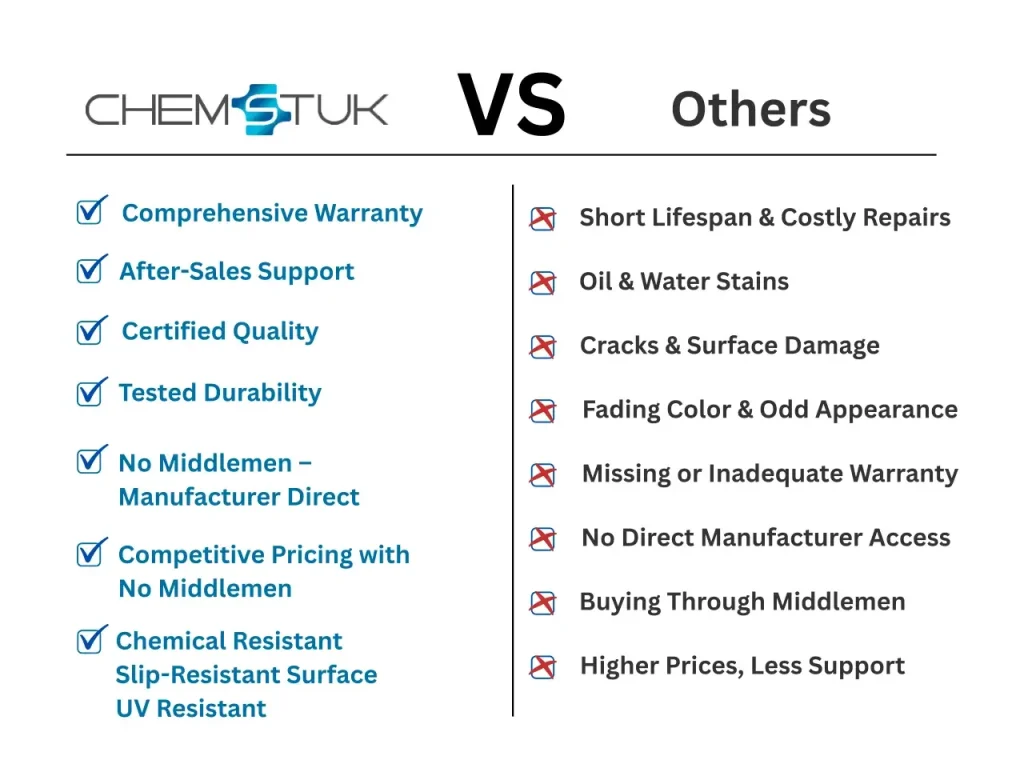
Why Choose Chemstuk for Epoxy Coatings in Australia?
At Chemstuk, we provide high-quality epoxy coating solutions tailored to Australian conditions.
- Extensive industry experience
- Wide range of coating systems
- Solutions for both residential and industrial projects
- Focus on durability and long-term performance
Whether you need a heavy-duty industrial floor or a decorative residential finish, our systems are designed to deliver reliable results.
Where Durability Meets Design
Frequently Asked Questions
What is the difference between epoxy coating and standard paint?
Epoxy coatings are far more durable than standard paint.
- Epoxy forms a thick, protective layer
- Paint is thinner and less resistant
- Epoxy lasts significantly longer
How long do epoxy coatings last?
The lifespan depends on usage:
| Environment | Estimated Lifespan |
|---|---|
| Residential | 5–10 years |
| Industrial | 7–15 years |
How thick should an epoxy coating be for different applications?
The thickness of an epoxy coating depends on how the space will be used:
Light residential use: 1–2 mm
Garage floors: 2–3 mm
Industrial environments: 3–5 mm or more
Thicker systems provide better durability and resistance, especially in high-traffic or heavy-duty areas.
Can epoxy coatings be applied over existing concrete floors?
Yes, epoxy coatings can be applied over existing concrete, but proper preparation is essential.
Before application:
- The surface must be clean and dry
- Any cracks or damage should be repaired
- The floor should be mechanically prepared (grinding)
A well-prepared surface ensures strong adhesion and a long-lasting finish.